Introduction
Marketing plays a pivotal role in every thriving business. No matter whether you run a startup or a multinational organization, marketing will help you reach your prospects, develop brand identity, and boost sales. The way marketing used to work has drastically changed throughout the years. Newspapers, television, radio, and billboards were among the most widely-used marketing tools until the era of internet and mobile phones started booming.
Today, the debate around Digital Marketing vs Traditional Marketing has become more relevant than ever. Nowadays, businesses have to ask themselves whether they should go for digital marketing or stay with traditional marketing. Both marketing strategies have their advantages and disadvantages, but knowing the difference between them will surely help you make the right decision.
Here, in this detailed guide, we will compare digital marketing and traditional marketing by the cost, reach, engagement, targeting, ROI, and effectiveness.
What is Traditional Marketing?
Traditional marketing implies using promotional tools that existed prior to the popularity of the internet. These marketing techniques involve the use of offline tools.
Common Types of Traditional Marketing
- Television advertisements
- Radio commercials
- Newspaper advertisements
- Magazine advertisements
- Billboards
- Flyers and brochures
- Posters
- Direct mail
- Telemarketing
- Event sponsorships
Traditional marketing has been the foundation of advertising for decades and still plays an important role in many industries.
Example
Imagine a clothing brand launching its summer collection. They may advertise through television commercials, newspaper ads, and roadside billboards to attract customers.
What is Digital Marketing?
Digital marketing refers to promoting products or services using digital technologies and internet-based platforms.
Businesses use online channels to connect with customers wherever they spend their time online.
Common Types of Digital Marketing
- Content Marketing
- Social Media Marketing
- Email Marketing
- Pay-Per-Click (PPC) Advertising
- Affiliate Marketing
- Influencer Marketing
- Video Marketing
- Mobile MarketingSearch Engine Optimization (SEO)
- Search Engine Marketing (SEM)
Digital marketing allows businesses to target specific audiences, monitor campaign performance, and optimize strategies in real time.
Example
The same clothing brand can advertise its summer collection through Instagram, Facebook Ads, Google Search Ads, YouTube videos, and email newsletters.
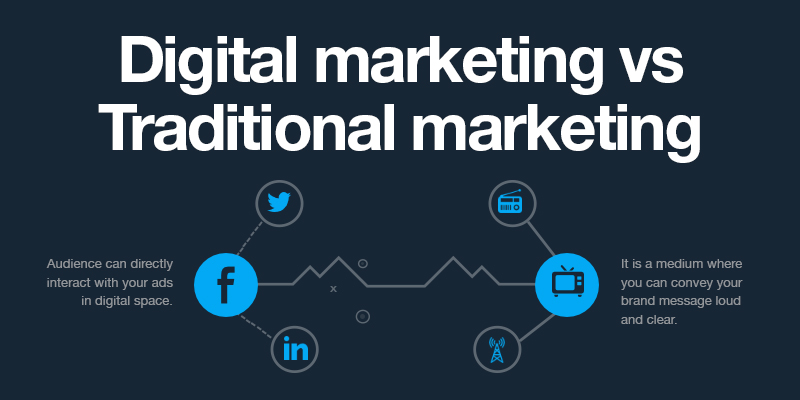
Major Differences Between Digital Marketing and Traditional Marketing
1. Marketing Channels
Conventional marketing employs traditional modes of communication which include television, newspapers, radio, and outdoor advertising.
Digital marketing involves online platforms such as Google, Facebook, Instagram, LinkedIn, YouTube, websites, mobile applications, and emails.
Winner: Digital Marketing
2. Audience Reach
Conventional marketing tends to target a local or regional market.
Digital marketing makes it possible for companies to connect to their customers worldwide in a matter of seconds.
Examples include:
- Newspaper advertisement can be limited to one city.
- Google Ads can connect with millions of people around the world.
Winner: Digital Marketing
3. Cost Effectiveness
Traditional marketing campaigns require a large investment.
Examples include:
- TV advertisements
- Newspaper printing
- Billboard rentals
- Radio promotions
Digital marketing offers affordable options for businesses of all sizes.
Small businesses can start advertising with a modest daily budget while still reaching targeted audiences.
Winner: Digital Marketing
4. Target Audience
Traditional marketing reaches a broad audience with limited targeting.
Digital marketing allows businesses to target customers based on:
- Age
- Gender
- Location
- Interests
- Purchase behavior
- Income
- Occupation
- Device usage
This precision significantly improves campaign effectiveness.
Winner: Digital Marketing
5. Customer Engagement
Traditional marketing mostly provides one-way communication.
Customers simply watch or read advertisements.
Digital marketing encourages two-way communication through:
- Comments
- Likes
- Shares
- Reviews
- Live chats
- Emails
- Social media messages
Businesses can build stronger relationships with customers.
Winner: Digital Marketing
6. Measuring Results
One major limitation of traditional marketing is the difficulty in measuring campaign performance.
Businesses often rely on estimates.
Digital marketing provides detailed analytics such as:
- Website traffic
- Conversion rate
- Click-through rate (CTR)
- Bounce rate
- Cost per click (CPC)
- Return on Ad Spend (ROAS)
- Customer acquisition cost
These insights help marketers improve campaigns continuously.
Winner: Digital Marketing
7. Return on Investment (ROI)
The conventional marketing campaign takes several weeks or months before evaluation.
With digital marketing, one gets the immediate performance details of the campaign.
One is able to make changes in the campaigns to increase the return on investment.
Winning side: Digital Marketing
8. Flexibility
In case of newspaper and television advertisements, once the advertisements go live, changes cannot be made.
Changes can be made immediately in digital marketing campaigns.
Examples include:
- Changing ad copy
- Updating landing pages
- Adjusting budgets
- Testing different creatives
Winner: Digital Marketing
9. Personalization
Traditional marketing delivers the same message to everyone.
Digital marketing enables personalized experiences based on user preferences and behavior.
Examples:
- Personalized emails
- Product recommendations
- Retargeting ads
- Dynamic website content
Customers are more likely to engage with personalized marketing.
Winner: Digital Marketing
10. Speed
The preparation of an ordinary marketing campaign usually takes weeks.
Digital marketing campaigns can be launched within minutes.
Organizations have the ability to respond rapidly to market trends and consumer behavior.
Winner: Digital Marketing
Advantages of Traditional Marketing
While digital marketing is expanding quickly, there are some advantages of traditional marketing that should be highlighted.
Establishes Trust Locally
The local press and TV stations may have good trustworthiness with their audience.
Creates Strong Brands
There is strong brand recognition created by big billboards and TV commercials.
Reaches Non-Digital Audiences
The older generation depends more on newspapers, TV, and radio rather than digital media.
Physical Media
There are some printed materials like brochures, magazines, and catalogs available.
Disadvantages of Traditional Marketing
- Expensive advertising costs
- Difficult to measure ROI
- Limited audience targeting
- No real-time optimization
- One-way communication
- Short campaign lifespan
- Limited interaction
Advantages of Digital Marketing
Digital marketing has transformed how businesses communicate with customers.
Affordable
Businesses can start campaigns with relatively small budgets.
Global Reach
A website or social media campaign can reach audiences worldwide.
Better Targeting
Businesses can show advertisements to users most likely to become customers.
Real-Time Analytics
Campaign performance can be monitored instantly.
Higher Engagement
Customers can interact through comments, messages, and reviews.
Better ROI
Marketing budgets are optimized based on measurable results.
Easy Optimization
Campaigns can be improved continuously using performance data.
Disadvantages of Digital Marketing
Despite its advantages, digital marketing has some limitations.
High Competition
Millions of businesses compete for online visibility.
Constant Algorithm Changes
Search engines and social media platforms regularly update their algorithms.
Requires Technical Knowledge
Businesses need expertise in SEO, analytics, advertising platforms, and content creation.
Privacy Concerns
Data privacy regulations require marketers to handle customer information responsibly.
Comparison Table
| Feature | Traditional Marketing | Digital Marketing |
| Cost | High | Affordable |
| Audience Reach | Local | Global |
| Targeting | Limited | Highly Specific |
| Analytics | Difficult | Real-Time |
| Customer Interaction | One-Way | Two-Way |
| Campaign Updates | Difficult | Instant |
| ROI Tracking | Limited | Accurate |
| Personalization | Low | High |
| Flexibility | Low | High |
| Speed | Slow | Fast |
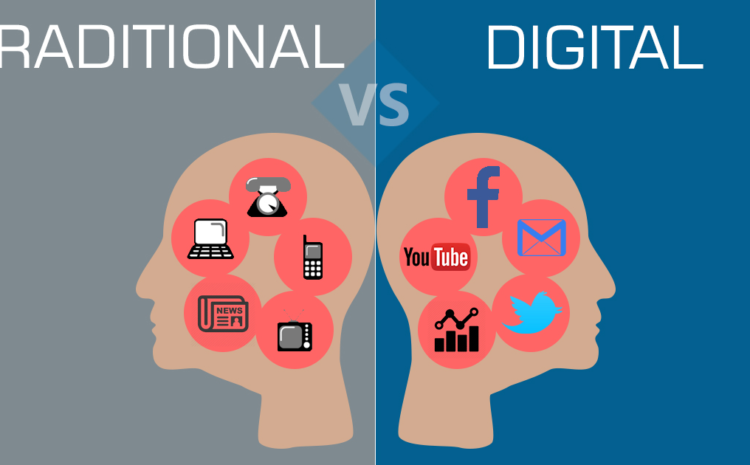
Which Marketing Strategy is Better?
The right marketing strategy depends on several factors:
- Business size
- Budget
- Target audience
- Industry
- Marketing goals
For instance:
A local supermarket might be helped by distributing flyers and advertisements in the local newspaper.
A company that uses e-commerce to sell globally should do better by using SEO, social media marketing, and Google ads.
Most successful businesses use a combination of both strategies.
This strategy is called IMC (Integrated Marketing Communications).
Future of Marketing
The future of marketing is increasingly digital.
Emerging technologies such as:
- Artificial Intelligence (AI)
- Machine Learning
- Voice Search
- Chatbots
- Marketing Automation
- Augmented Reality (AR)
- Virtual Reality (VR)
are reshaping customer experiences.Digital transformation in companies will give them a competitive edge.
Traditional marketing will still play its part, particularly in cases where the presence of physical trust is needed.
Best Approach: Using Both Methods
Companies can use both these methods rather than selecting only one of them.
For instance:
- Publicize TV commercials using social media.
- Attach QR codes in brochures directing to their websites.
- Ask people reading newspapers to follow the company on social media.
- Utilize billboards to advertise digital campaigns or apps.
Conclusion
There is something special about digital marketing vs traditional marketing. Traditional marketing still has its value when it comes to building trust among the locals, making sure that the brand gets recognized, and reaching people who are consumers of traditional media. Digital marketing has many things to offer in comparison to traditional marketing because it is affordable, easy to target and measure, customer engagement and it reaches out to the whole world.
In our very connected world today, businesses that apply digital marketing in their strategy have an advantage because they are flexible and they have a high return on investment. On the other hand, combining traditional marketing techniques with digital marketing will create even better marketing campaign.
Therefore, in digital marketing vs traditional marketing, it all comes down to what type of objectives you have and what type of budget you have.